

Easily To Pass New JN0-682 Premium Exam Updated [Feb 05, 2024]
JN0-682 Certification All-in-One Exam Guide Feb-2024
Successful candidates of the JN0-682 exam will have a deep understanding of data center technologies and will be able to design, deploy, and troubleshoot data center solutions using Juniper Networks technologies. Data Center, Professional (JNCIP-DC) certification will help professionals to advance their careers in the field of data center technologies and will open up new opportunities for them in the industry. Overall, the JN0-682 exam is an excellent choice for professionals who want to validate their expertise in data center technologies and enhance their career prospects.
To obtain the JN0-682 certification, candidates must pass a 65-question multiple-choice exam. JN0-682 exam is administered by Pearson VUE and can be taken at any of their testing centers worldwide. JN0-682 exam is timed and candidates have 120 minutes to complete it. The passing score for the exam is 70% and candidates who pass the exam will receive their certification from Juniper Networks.
Juniper JN0-682 (Data Center, Professional (JNCIP-DC)) certification exam is designed for professionals who want to demonstrate their expertise in data center technologies and solutions. It is an intermediate-level certification exam that covers a range of topics related to data center design, implementation, and management. The JN0-682 exam is an excellent choice for individuals who want to enhance their skills and knowledge in the field of data center networking.
NEW QUESTION # 27
You have deployed a VXLAN as shown in the exhibit Leaf1, leaf3, spine1, and spine2 have been configured as VTEPs. Host1 cannot communicate with host2.
Referring to the exhibit, how would you solve this problem?
- A. A layer 3 VXLAN gateway must be configured on at least on at least one of the devices
- B. Host1 and host2 must be placed in the same VRF
- C. A DCI connected must be created between the VLANs
- D. The VLAN ID on the connected to host2 must be changed to VLAN 100
Answer: A
NEW QUESTION # 28
You are asked to enable visibility into your EVPN-VXLAN network traffic by monitoring traffic continuously. Which two statements are correct in this scenario? (Choose two.)
- A. The sFlow agent needs to be manually installed on your QFX Series switch.
- B. The sFlow agent is installed by default on your OFX Series switch.
- C. You cannot enable sFlow monitoring on each interface individually.
- D. You must enable sFlow monitoring on each interface individually.
Answer: C
NEW QUESTION # 29
You are designing a network for a small data center. In this scenario, which underlay protocol allows for the simplest implementation?
- A. EBGP
- B. IGGP
- C. MPLS
- D. OSPF
Answer: D
NEW QUESTION # 30
Exhibit.
You choose the EBGP design shown in the exhibit as your IP fabric design. You must ensure that both routes received by the spine nodes will be used for ECMP forwarding Which BGP parameter would need to be added to the EBGP configuration of the spine nodes to achieve this goal?
- A. multipath
- B. multipath multiple-as
- C. add-path
- D. multihop
Answer: B
NEW QUESTION # 31
You are configuring an IP Fabric in your data center and you are trying to load-balance traffic across multiple
equal-cost BGP routes. You have enabled multipath, but the traffic is not being load-balanced.
Referring to the exhibit, what will solve this problem?
- A. You should apply load-balance policy as an import policy to the forwarding table
- B. You should apply the load-balance policy as an export policy for the BGP neighbor
- C. You should apply the load-balance policy as an export policy to the forwarding table
- D. You should apply the load-balance policy as an export policy to the BGP neighbor
Answer: C
NEW QUESTION # 32
You are considering deploying a MAC-VRF type routing instance with a VLAN-bundle service type. In this scenario, which two statements are correct? (Choose two.)
- A. Multiple VLAN IDs per EVI are supported.
- B. It can be implemented in a bridge overlay architecture.
- C. VLAN normalization is supported.
- D. It can be implemented in an ERB architecture.
Answer: A,B
NEW QUESTION # 33 


You have deployed a multitenant EVPN-VXLAN fabric. You must have the routes in the BLUE VRF show up in the RED VRF. In this scenario, how would you achieve this goal?
- A. Configure the RED route target in the BLUE VRF.
- B. Configure a VRF import policy on the RED VRF that matches the BLUE VRF route target.
- C. Configure a VRF export policy on the BLUE VRF that matches the RED VRF route target.
- D. Configure the BLUE route target in the RED VRF.
Answer: D
NEW QUESTION # 34
Exhibit.
A VXLAN has been created between devices leaf1 and Ieaf3.
Referring to the exhibit, which statement is true?
- A. Traffic sent from host1 to host2 will be tagged with VLAN ID 200 when exiting Ieaf3.
- B. Traffic sent from host1 to host2 will be dropped on Ieaf3.
- C. Traffic sent from host1 to host2 will be dropped on leaf1.
- D. Traffic sent from host1 to host2 will be tagged with VLAN ID 100 when exiting Ieaf3.
Answer: C
NEW QUESTION # 35
You are asked to enable visibility into your EVPN-VXLAN network traffic by monitoring traffic continuously. Which two statements are correct in this scenario? (Choose two.)
- A. The sFlow agent is installed by default on your OFX Series switch.
- B. You cannot enable sFlow monitoring on each interface individually.
- C. The sFlow agent needs to be manually installed on your QFX Series switch.
- D. You must enable sFlow monitoring on each interface individually.
Answer: A,D
NEW QUESTION # 36
Your manager asks you to secure ARP and DHCP traffic across your local Ethernet links
In this scenario, which technology will accomplish this task?
- A. A firewall filter
- B. SSL
- C. MAC sec
- D. IPsec
Answer: C
NEW QUESTION # 37
You are asked to deploy an Ethernet bridging design in a data center with the following criteria:
--routing must occur on the leaf devices.
--VTEPs must terminate on the leaf devices.
--facilitate inter-VLAN communication, -- lower latency with East-West traffic.
Which architecture should you use in this scenario?
- A. centrally-routed bridging architecture
- B. edge-routed bridging architecture
- C. bridge overlay architecture
- D. collapsed spine architecture
Answer: B
NEW QUESTION # 38
You are evaluating which method to use for learning MAC addresses in your VXLAN network. Which statement is true in this scenario?
- A. EVPN exchanges MAC addresses through data plane learning and is more reliable than multicast.
- B. EVPN exchanges MAC addresses through control plane learning and is more reliable than multicast.
- C. Multicast exchanges MAC addresses through control plane learning and is not more reliable than EVPN.
- D. Multicast exchanges MAC addresses through data plane learning and is more reliable than EVPN.
Answer: C
NEW QUESTION # 39
Which two characteristics would you consider when selecting spine devices in an IP fabric?
(Choose two.)
- A. port density
- B. data center location
- C. scaling limitations
- D. spanning tree limitations
Answer: B,D
NEW QUESTION # 40
You are evaluating which method to use for learning MAC addresses in your VXLAN network. Which statement is true in this scenario?
- A. Multicast exchanges MAC addresses through control plane learning and is not more reliable than EVPN.
- B. EVPN exchanges MAC addresses through data plane learning and is more reliable than multicast.
- C. Multicast exchanges MAC addresses through data plane learning and is more reliable than EVPN.
- D. EVPN exchanges MAC addresses through control plane learning and is more reliable than multicast.
Answer: D
NEW QUESTION # 41
When using EBGP as the underlay protocol for your IP fabric architecture, which two statements are true? (Choose two.)
- A. Leaf nodes only peer to spine nodes
- B. Spine nodes only peer to leaf nodes
- C. Spine nodes peer to both leaf and spine nodes
- D. Leaf nodes peer to both spine and leaf nodes
Answer: A,B
NEW QUESTION # 42
Your colleague has begun working on the base configuration for an active-active multihomed EVPN connection shown in the exhibit.
Which two actions will ensure a successful implementation? (Choose two.)
- A. Change the ESI mode on PE1 to signal-active
- B. Change the ESI mode on PE2 to all-active
- C. Change the ESI value on the PE1 device to 00.22.44.88.00.22.44.66.88
- D. Change the ESI value on the PE2 device to 00.00.00.00.00.00.00.00.00.00
Answer: B,C
NEW QUESTION # 43
An EVPN-signaled VXLAN overlay has been deployed in the network shown in the exhibit. An EVPN LAG has been configured to connect host1 to the network, and device leaf1 has been elected as the designated forwarder.
In this scenario, which statement is true?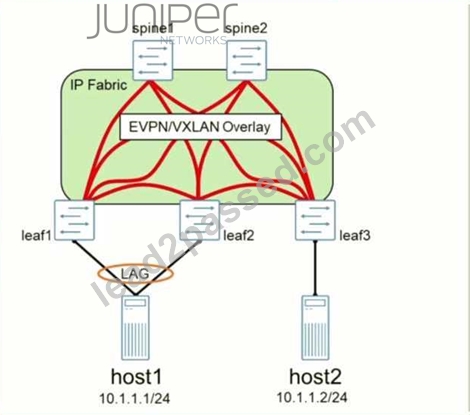
- A. The Ieaf3 device will only receive an advertisement to the LAG segment from leaf1.
- B. The Ieaf3 device can utilize both leaf1 and Ieaf2 to forward unicast packets from host2 to host1.
- C. Broadcast packets sent from host2 will not be forwarded to Ieaf2.
- D. An ICCP control link must be configured between leaf1 and Ieaf2.
Answer: A
NEW QUESTION # 44
Referring to the exhibit, each node in the IP fabric is peering to its directly attached neighbor using EBGP. Each node is peering using physical interface IP addresses. Leaf 2 and Leaf 3 are advertising the 10.1.1/24 network into EBGP. Spine 2 must be configured so that it can load- share traffic destined to the 10 1.1/24 network over both next-hop A and next-hop B.
Which two actions must be performed to accomplish this task? (Choose two.)
- A. Use advertise inactive
- B. Use a load-balancing policy applied to the forward table
- C. Use multihop
- D. Use multipath multipath-As
Answer: B,D
NEW QUESTION # 45
What is the purpose of the command shown in the exhibit?
- A. To disable the group2390.0.1 across the entire VXLAN.
- B. To stop the reception of transit multicast traffic when there are no interested receives attached to the local VTEP
- C. To disallow IGMP request for the group 239.0.01 from host attached to the local VTEP
- D. To stop the transmission of transit multicast traffic when there are no interested receives attached to a remote VTEP
Answer: D
NEW QUESTION # 46
You are deploying a VXLAN using signaling overlay network in your new data center. You are able to establish your MP BGP peering session and see your EVPN routes, but traffic will not traverse the VXLAN using signaling overlay network.
What is a solution to this problem?
- A. Increase the protocol MTU on all devices participating in VXLAN using EVPN signaling
- B. Increase the MTU on the logical VTEP source interface of all devices participating in VXLAN using EVPN signaling.
- C. Increase the physical MTU on all ports on all devices participating in VXLAN using EVPN signaling.
- D. Enable the mtu-discovery feature on the MP peering sessions between VXLAN ANs EVPN signaling peers.
Answer: C
NEW QUESTION # 47
A client with five data centers spread around the country uses MPLS L2VPNs to provides point- to- point data center interconnect between each data center in a full-mesh network. The client Is considering an MPLS EVEN implementation.
In this scenario, what are three advantages of using MPL5 EVEN interconnects? (Choose two.)
- A. They provide for a MAC learning in the control plane.
- B. They provide for lower transmission latency.
- C. They provide for a local proxy ARP/ND resolution.
- D. The provide for static configuration that does not require a Dynamic Routing Protocol
- E. They provide for point to multipoint connectivity
Answer: A,C,E
NEW QUESTION # 48
You are designing a Layer 3 fabric underlay using EBGP. You will implement an E VPN-signaled VXLAN
overlay on the Layer 3 fabric.
In this scenario, what must you do in the underlay to ensure that the VXLAN overlay will be able to function
properly?
- A. The underlay should advertise the host connected interlaces on all leaf device
- B. The underlay should support the PIM protocol
- C. Each device in the underlay should advertise its loopback address
- D. The underlay should be configured with a separate VRF tor each potential tenant
Answer: C
NEW QUESTION # 49
You have configured a new MC-LAG connection to a host. After committing the configuration, the MC-LAG link is not functioning properly.
Referring to the exhibit, how would you solve this problem?
- A. Configure status-control on qfx2 to active
- B. Change the mc-ae is on qfx1 to 1
- C. Change the chassis on qfx1 to 1
- D. Configure a system-id on qfx1 that is different from the system-id on qfx2
Answer: B
NEW QUESTION # 50
......
Last JN0-682 practice test reviews: Practice Test Juniper dumps: https://certblaster.lead2passed.com/Juniper/JN0-682-practice-exam-dumps.html