

Use Salesforce Plat-Dev-210 Dumps To Succeed Instantly in Plat-Dev-210 Exam
Ultimate Guide to Plat-Dev-210 Dumps - Enhance Your Future Career Now
NEW QUESTION # 72
Refer to the exhibit. What JSON from the DRGetAccountDetails action would display all six values correctly in the OmniScript structure shown? BlkContacts is a Repeat Block.
- A.

- B.

- C.

- D.

Answer: B
Explanation:
According to the OmniScript Data JSON page, the OmniScript structure JSON defines the data elements and their properties that are used in an OmniScript. The exhibit shows an OmniScript structure JSON with six elements: AccountName, AccountNumber, AccountType, AccountOwner, ContactName, and ContactPhone. The DRGetAccountDetails action is a DataRaptor Extract action that retrieves data from the Account and Contact objects in Salesforce. The BlkContacts element is a Repeat Block that displays a list of contacts related to the account. Therefore, the JSON from the DRGetAccountDetails action that would display all six values correctly in the OmniScript structure shown is option C, which has the following structure:
{
The other options have different structures that do not match the OmniScript structure shown.
Therefore, the correct answer is C.
NEW QUESTION # 73
A developer configures a FlexCard with a Data Mapper data source that uses the params.id as an input. When the developer clicks "View Data" on the FlexCard, valid data displays. However, when the developer previews the layout, the FlexCard does not display.
What could cause this error?
Choose 2 answers
- A. The RecordId in the Test Data Source Settings is for the wrong record type.
- B. The Data Node field for the FlexCard is empty.
- C. There is no Salesforce record for the FlexCard based on the RecordId in the layout's Test Data Source Settings.
- D. The Attributes haven't been configured to pass the data to the fields.
Answer: B,C
Explanation:
This scenario relates to FlexCard preview behavior and data mapping issues.
* B. There is no Salesforce record for the FlexCard based on the RecordId in the layout's Test Data Source Settings - If the test record does not exist, the FlexCard will not display any data during preview. This is a common setup mistake.
* C. The Data Node field for the FlexCard is empty - The Data Node field must be set correctly to match the JSON node where the expected data resides. If it is empty or incorrect, the FlexCard won't bind data to UI elements.
Incorrect Options:
* A. Even if the RecordId is from a different record type, as long as the data structure aligns, it would still render; it's not a definitive reason for the card failing to display.
* D. Attributes are not required to display field values directly; they are used for passing data between cards or from context, not for direct field rendering.
:
Salesforce OmniStudio # FlexCard Data Source Setup & Troubleshooting
NEW QUESTION # 74
A developer creates an OmniScript to update billing information. After analyzing the different types of customer interactions that occur at the company, the developer determines updating billing information should be included in the majority of customer interactions, which are represented by more than 20 different FlexCards.
What is the most efficient way for the developer to configure the action that invokes the OmniScript?
- A. As an OS Action
- B. As an OmniStudio Action
- C. As a Custom Action
- D. As a Lightning Action
Answer: A
Explanation:
An OS Action is the most efficient way to configure the action that invokes the OmniScript, as it allows the developer to reuse the same OmniScript across multiple FlexCards without creating separate actions for each one. A Custom Action is used to invoke a custom Apex class or Lightning web component. An OmniStudio Action is used to invoke an Integration Procedure or a Calculation Procedure. A Lightning Action is used to invoke a Lightning component or a Visualforce page.
NEW QUESTION # 75
What is the primary purpose of the Preview feature in the OmniScript Designer?
- A. To create a FlexCard from the OmniScript
- B. To test the OmniScript's flow, logic, and integrations before activation
- C. To generate Apex test classes automatically
- D. To deploy the OmniScript to production
Answer: B
Explanation:
The Preview feature lets developers step through the OmniScript as an end user would, testing conditional logic, validations, and integration calls prior to activating it for use.
NEW QUESTION # 76
On a FlexCard canvas, several fields display with Salesforce data, but one of the fields shows only the label. What could cause this?
- A. In the Setup Pabel, {recordId} is misspelled in the Data Source Input Map.
- B. There are No test Data test Parameters configured.
- C. The field name in the FlexCard state does not match the DataRaptorExtract's Output JSON Path name.
- D. In the FlexCard state, the Field type for the field does not match the type in the Salesforce record.
Answer: C
Explanation:
According to the FlexCard Designer Overview page, one possible cause of a field showing only the label is that "the field name in the FlexCard state does not match the DataRaptor Extract's Output JSON Path name".
NEW QUESTION # 77
The OmniScript must retrieve device details stored in the Asset object and then call an external system to send troubleshooting commands via REST API to the device.
Which two OmniScript element should the developer use to configure this functionality?
- A. DataRaptor Extract Action
- B. REST API Action
- C. SOQL Action
- D. Navigation Action
- E. HTTP Action
Answer: A,E
Explanation:
According to the OmniScript Action Elements page, a DataRaptor Extract Action can be used to "get data from one or more Salesforce records" and an HTTP Action can be used to "get, save, or delete data through a web application programming interface (API)".
NEW QUESTION # 78
A developer creates an Integration Procedure with a Set Values and a DataRaptor Extract Action that requires AccountId as a key. When the developer previews the Integration Procedure, thedeveloper enters the AccountId correctly and execute the Preview. The developer sees the data extract by the DataRaptor in the Debug Log, but the response is empty. What is the likely cause of this issue?
- A. The AccountId used for the preview is invalid.
- B. A Response Action was not added to the integration Procedure.
- C. The Response cannot be previewed directly.
- D. The DataRaptor Action did not have the add response Ro Response JSON property set to true.
Answer: B
Explanation:
According to the OmniStudio Developer Guide, "To return a response from an Integration Procedure, add a Response action as the last action in your Integration Procedure." Therefore, the correct answer is C.
NEW QUESTION # 79
A healthcare company wants to enable its subscribers to add, edit, or delete dependents related to their policy via their Community portal. The developer on the project decides to use an OmniScript.
How should the developer configure the OmniScript to provide this functionality?
- A. Use an Input Block element and a Data Mapper Post Action element.
- B. Use a Text Block element and a Remote Action element.
- C. Use an Edit Block element configured with Remote Actions.
- D. Use an Edit Block element configured with SOQL statements.
Answer: C
Explanation:
In OmniStudio, the Edit Block element is purpose-built for allowing users to dynamically add, edit, or delete rows of related data, such as dependents under a policy. To save these changes, Remote Actions (typically backed by Apex or API) are used to process each record operation (Create/Update/Delete).
* A. Use an Edit Block element configured with Remote Actions - Correct. This is the recommended and most scalable way to support CRUD operations in OmniScripts for collections (e.g., dependents).
The Edit Block provides UI-level support, while Remote Actions handle back-end interaction with Salesforce or external systems.
Incorrect Options:
* B. Text Block is for display purposes and cannot manage data input or backend actions.
* C. Input Block elements do not support row-level add/edit/delete functionality as Edit Blocks do.
* D. SOQL is a read-only query language and cannot be used to update or delete records directly within an OmniScript.
:
Salesforce OmniStudio Guide # OmniScript Edit Block Element
OmniStudio Best Practices # CRUD Operations in OmniScripts
NEW QUESTION # 80
A developer is creating a Flex Card for a new Community page. The FlexCard will display case information along with action to close the case and update the case. And it will be styled using the Community's theme. What must be developer do to configure the FlexCard for deployment in a community?
- A. Set the Target property in publishing Options to the Community page''
- B. Configure the Component visibility in the custom Component.
- C. Add the FlexCard's API name to FlexCard Player component
- D. Set the Developer property in Card Configuration to `'Community''
Answer: A
Explanation:
The Target property in publishing Options determines where the FlexCard will be displayed.
Setting it to the Community page will make the FlexCard available in the community
NEW QUESTION # 81
A developer needs to persist data entered in an OmniScript to a custom Salesforce object after the OmniScript is submitted. Which action is most appropriate?
- A. DataRaptor Extract Action
- B. Remote Action only
- C. Formula Action
- D. DataRaptor Load Action (or Integration Procedure with a DataRaptor Load)
Answer: D
NEW QUESTION # 82
Refer to the exhibit below. In this Integration Procedure structure, what Send JSON Path would you use to send the output of the ActionZ element to a Response Action?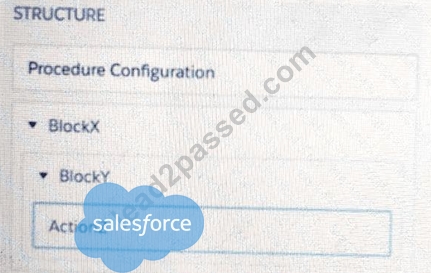
- A. ActionZ:BlockY:BlockX
- B. ActionZ:BlockY:BlockX
- C. BlockX.BlockYActionZ
- D. BlockX:BlockY:ActionAZ
Answer: C
Explanation:
The Send JSON Path syntax for accessing an element from an Integration Procedure structure is BlockName.
ElementName. In this case, the BlockName is BlockX and the ElementName is ActionZ. The colon (:) is used to separate the input and output parameters, not the block and element names. The order of the block and element names should follow the hierarchy of the structure, from top to bottom.
NEW QUESTION # 83
What OmniStudio tool pre-populates the data m a PDF used by an OmniScript?
- A. A DataRaptor Extract
- B. A DataRaptor Transform
- C. A DataRaptor Load
- D. A SOQL Query
Answer: B
Explanation:
According to the DataRaptor Transform Overview page, a DataRaptor Transform can be used to
"pre- populate data in PDFs used by OmniScripts".
NEW QUESTION # 84
A developer needs to build a multi-step intake form. Each step must allow the user to cancel the intake at any time. The developer is using an LWC OmniScript to build the form. How should the developer implement the cancel functionality for all steps using the LWC OmniScript Designer?
- A. Add a navigation Action outside each step and set the Element Name to `'Cancel'',
- B. Check the Enable Cancel checkbox in the Setup tab under Cancel Options.
- C. Add a navigation Action inside each step and set the Component name to `'Cancel'',
- D. Add a navigation Action inside each step and set the Element Name to `'Cancel'',
Answer: B
Explanation:
Checking the Enable Cancel checkbox in the Setup tab under Cancel Options allows the developer to enable the cancel functionality for all steps in the OmniScript. The user can cancel the OmniScript at any time by clicking the Cancel button in the top right corner of the OmniScript.
Adding a navigation Action inside each step is not necessary and would clutter the OmniScript design. Setting the Component name or Element Name to `'Cancel'' has no effect on enabling the cancel functionality.
NEW QUESTION # 85
A developer is creating an OmniScript that provisions trail orgs to their customers. The following text block in the Omniscript uses a merge code to display the ID for the new trail org:
- A. To %sDetails: Customer|0: ID$
- B. To %%sDetails: Customer|0: ID%%
- C. To %Details: Customer|n: ID%
- D. To %Details: Customer|1: ID%
Answer: D
Explanation:
The correct syntax for merge codes in OmniScript is %%sNodeName%%, where NodeName is the name of the JSON node in the data source. The other options are either missing the s or using incorrect symbols.
NEW QUESTION # 86
A customer sets up to LWC Omniscripts, one embedded into another. Account is set in a Set Values element in the parent Omniscript.
The AccountId set in the parent Omniscript is used to another Set Values element ContextAccountid in the embedded OmniScript. The embedded Omniscript is activated.
While previewing the OmniScript flow from the parent, it is found that Account is set correctly in the parent OmniScript. However. ContextAccountId in the embedded OmniScript is not set with the AccountId from parent Omniscript. On previewing the embedded OmniScript individually, it is found that ContextAccountId is set correctly.
What is the reason for this? Refer to the exhibit below.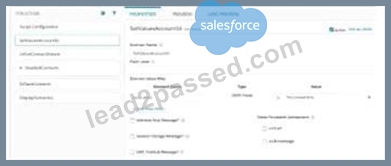

- A. A developer failed to include a Navigation Element to pass data from the parent OmniScript.
- B. The LWC PubSub Message flag in the Set Values action of the parent has not been set.
- C. The flag pass Data JSON in the parent OmniScript in not configured correctly.
- D. Both parent and embedded OmniScripts have the same element name for the Set values element.
Answer: A
Explanation:
The LWC PubSub Message flag in the Set Values action of the parent OmniScript enables the parent OmniScript to send data to the embedded OmniScript using a custom event. If this flag is not set, the data will not be passed to the embedded OmniScript.
NEW QUESTION # 87
A developer needs to transform contact data into a JSON array.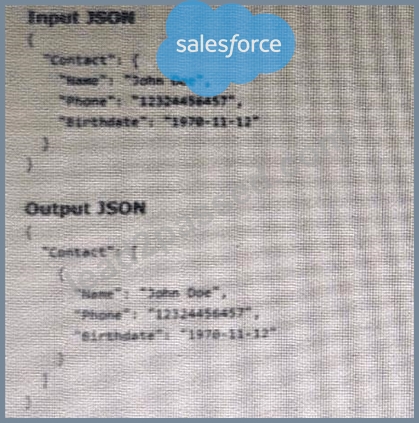
Given the input JSON shown above, what are two ways a developer could configure a DATA Raptor transform to achieve the expected Output JSON? Choose 2 answers
- A. Set the Input JSON path as List(Contact) and the Output JSON Path as Contact.
- B. Set the Input JSON Path as Contact the out JSON Path as Contact and the output Data type as List.
- C. Set the input JSON Path as Contact and the OutPut JSON Path as List (Contact)
- D. Use a formula LIST(Contact), and add the output of the formula as the input in the Transform tab.
Answer: B,D
Explanation:
A DataRaptor Transform can be used to transform data from one format to another, such as JSON, XML, or CSV. The developer can specify the input and output paths for each field in the Transform tab. The developer can also use formulas to manipulate data in the Formula tab1. To transform contact data into a JSON array, the developer can use either of these methods:
* Use a formula LIST(Contact), and add the output of the formula as the input in the Transform tab. This will create a list of contact objects from the input JSON and output it as a JSON array.
* Set the Input JSON Path as Contact, the Output JSON Path as Contact, and the Output Data Type as List. This will output each contact object as an element of a JSON array.
NEW QUESTION # 88
A developer is configuring the API URL in an HTTP Action element within an Integration Procedure.
What is the merge code syntax for passing a Date node from an element named SetValues in the URL?
- A. t 'SetValues' ] [ 'Date' ]
- B. %SetValues: Date%
- C. {{SetValues.Date}}
- D. %SetValues.Date%
Answer: D
Explanation:
In OmniStudio Integration Procedures, when referencing data from a prior step in the HTTP Action URL, the correct merge code syntax is:
* %ElementName.PropertyName%
So, referencing a value called Date from a step named SetValues must be written as:
* %SetValues.Date%
This is the format recognized by the OmniStudio Merge Language (OML) for dynamic value substitution in URLs or headers.
Incorrect Options:
* A. Invalid syntax - not recognized by OmniStudio merge logic.
* B. {{SetValues.Date}} is used in FlexCards, not in Integration Procedures.
* D. %SetValues: Date% is incorrect merge syntax due to space and colon use.
:
Salesforce OmniStudio Documentation # Merge Code Syntax for Integration Procedures
NEW QUESTION # 89
Which two of these options can a developer use to retrieve data from a Salesforce object?
Choose 2 answers
- A. A DataRaptor Load Action
- B. A DataRaptor Extract Action
- C. A Lookup Input Element
- D. A DataRapt or Post Action
Answer: A,C
Explanation:
A DataRaptor Load Action can be used to retrieve data from a Salesforce object by specifying the object name, fields, and filter criteria. A Lookup Input Element can be used to retrieve data from a Salesforce object by allowing the user to search for a record using a lookup field
NEW QUESTION # 90
A developer writes an OmniScript that includes a DataRaptor that updates the Account statue based on information provided from the OmniScript. The information must be updated only if the Account record already exists. Otherwise, a new account must be created. How should the developer accomplish this task?
- A. Populate the Lookup object and Lookup fields
- B. Check the Upset key and is required for Upsert checkboxes on the Account id field
- C. Check Overwrite Target for all Null input checkbox on the Account id field
- D. Check the Upsert key checkbox on the Account Status field
Answer: B
Explanation:
According to the OmniStudio Developer Guide, "To upsert a record, select the Upsert Key checkbox for the field that contains the unique identifier for the record. If you want to create a new record when no match is found, select Is Required for Upsert." Therefore, the correct answer is B.
NEW QUESTION # 91
In OmniScript, what is the purpose of the "Language" attribute when creating a new OmniScript?
- A. It defines the syntax used for Formula elements
- B. It allows multiple translated versions of the same OmniScript to exist, selected based on user locale
- C. It determines which programming language is used for custom Apex extensions
- D. It sets the default currency format for the OmniScript
Answer: B
Explanation:
The Language attribute, combined with Type and Sub Type, uniquely identifies an OmniScript version, allowing developers to create multiple language-specific versions that are served based on the user's locale settings.
NEW QUESTION # 92
Refer to the exhibit below. What JSON code correctly represents the step in the OmniScript Structure panel shown?
- A.

- B.

- C.

- D.
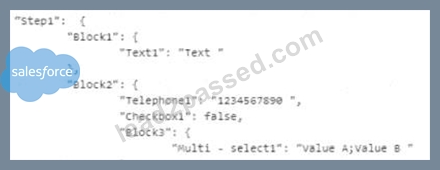
Answer: A
Explanation:
The JSON code correctly represents the step in the OmniScript Structure panel shown. The JSON code has the following properties:
* The type is "Step", which indicates that this is a step element in the OmniScript.
* The label is "Step 1", which matches the label shown in the panel.
* The name is "Step1", which matches the name shown in the panel.
* The elements property is an array that contains one element, which is a text field.
* The text field element has the following properties:
* The type is "Text", which indicates that this is a text field element.
* The label is "Text Field 1", which matches the label shown in the panel.
* The name is "TextField1", which matches the name shown in the panel.
* The value property is an empty string, which indicates that this text field has no default value.
NEW QUESTION # 93
A developer needs to limit the of a DataRaptorExtract to a maximum of one result.
How should the developer configure this?
- A. Set the Limit Property on the Action that calls the DataRaptor Extract.
- B. Use the LIMIT filter on the Extract definition
- C. Use a Custom Output Type when creating the DataRaptor
- D. Define a formula with the Filter function
Answer: B
Explanation:
Using the LIMIT filter on the Extract definition allows the developer to specify the maximum number of results to return from the DataRaptor Extract. Defining a formula with the Filter function is used to filter the results based on a condition. Using a Custom Output Type when creating the DataRaptor is used to define the structure of the output data. Setting the Limit Property on the Action that calls the DataRaptor Extract has no effect on limiting the results.
NEW QUESTION # 94
In a DataRaptor Transform, which tab is used to map input JSON fields to output JSON fields without querying Salesforce?
- A. Transform Tab
- B. Extract Tab
- C. Load Tab
- D. Formula Tab
Answer: A
Explanation:
The Transform tab of a DataRaptor Transform action maps input data (typically JSON) directly to output fields, reshaping data without querying or writing to Salesforce objects.
NEW QUESTION # 95
A healthcare company wants to enable its subscribers to add, edit, or delete dependents related to their policy Community portal. The developer on the project decides to use an MniScript.
How should the developer configure the OmniScript to providethis functionality?
- A. Use an Input Block element and a DataRaptor Post Action element.
- B. Use a Text Block element and a Remote Action element.
- C. Use an Edit Block element configured with Remote Actions.
- D. Use an Edit Block element configured with SOQL statements.
Answer: C
Explanation:
An Edit Block element configured with Remote Actions allows the developer to create a dynamic table that can display, add, edit, or delete records from a Salesforce object. The Remote Actions can be configured to perform CRUD operations on the object using SOQL or Apex.
NEW QUESTION # 96
......
Salesforce Plat-Dev-210 Exam Syllabus Topics:
| Topic | Details |
|---|---|
| Topic 1 |
|
| Topic 2 |
|
| Topic 3 |
|
| Topic 4 |
|
Salesforce Dumps - Learn How To Deal With The Exam Anxiety: https://certblaster.lead2passed.com/Salesforce/Plat-Dev-210-practice-exam-dumps.html