


Get Ready to Boost your Prepare for your NEX Exam with 152 Questions
Use Free NEX Exam Questions that Stimulates Actual EXAM
NEW QUESTION # 25
What is the term used to describe random changes in DNA, which may be silent, negative, or positive, to the organism in which they occur?
- A. Duplication
- B. Replication
- C. Mutation
- D. Recombination
Answer: C
Explanation:
A mutation is a random change in the DNA sequence of an organism. Mutations can occur due to errors during DNA replication, exposure to radiation, or chemical agents. These changes may have no effect (silent mutations), cause harm (negative mutations), or provide an advantage (positive mutations). Recombination refers to the exchange of genetic material during meiosis, not random DNA changes. Duplication involves copying a segment of DNA, and replication is the normal process of copying DNA before cell division. The NEX Science exam often emphasizes that mutations are a source of genetic variation and can influence evolution and disease. Understanding the different possible effects of mutations is essential for topics related to genetics, cancer biology, and inheritance.
NEW QUESTION # 26
Four students were comparing their test scores on an exam. All questions were worth the same number of points.
* Student A: 19 out of 26
* Student B: 75 out of 100
* Student C: 71%
* Student D: 0.719
Which student scored the highest on the exam?
- A. Student D
- B. Student B
- C. Student A
- D. Student C
Answer: C
Explanation:
This problem requires comparing fractions, percentages, and decimals by converting them to the same form.
Convert each score to a decimal. Student A: 19 ÷ 26 # 0.731. Student B: 75 ÷ 100 = 0.75. Student C: 71% =
0.71. Student D: already given as 0.719. Comparing these values, 0.75 is the highest. Therefore, Student B scored the highest. Option D (0.719) is close but still lower than 0.75. The NEX frequently tests comparison skills across different numerical formats, so converting everything to decimals is the safest approach.
======
NEW QUESTION # 27
Word Knowledge
The word"initial"most nearly means:
- A. First
- B. Delayed
- C. Final
- D. Lasting
Answer: A
Explanation:
"Initial" refers to the first stage or beginning of something. Option B best matches this definition. NEX questions frequently test sequencing vocabulary.
======
NEW QUESTION # 28
Where does saltatory conduction occur?
- A. Myelinated axons
- B. Unmyelinated axons
- C. Muscle cells
- D. Dendrites
Answer: A
Explanation:
Saltatory conduction is the rapid transmission of nerve impulses alongmyelinated axons. In myelinated neurons, the axon is covered with a fatty insulating layer called myelin, which is interrupted at gaps known as nodes of Ranvier. During saltatory conduction, the electrical impulse "jumps" from one node to the next, greatly increasing the speed of signal transmission. Unmyelinated axons conduct impulses more slowly because the signal must travel continuously along the entire membrane. Dendrites receive signals rather than transmit them over long distances, and muscle cells do not conduct nerve impulses in this manner. The NEX Science exam commonly tests nervous system physiology, particularly mechanisms that improve conduction speed, making myelinated axons the correct answer.
======
NEW QUESTION # 29
Review the image of the human digestive tract shown below.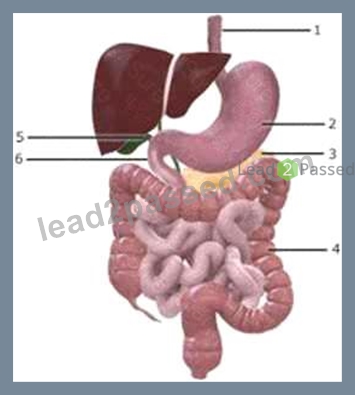
What is the principal process occurring in the region labeled 4?
- A. Hydrolysis of proteins
- B. Absorption of water
- C. Synthesis of triglycerides
- D. Assimilation of fatty acids
Answer: B
Explanation:
Region 4 in the diagram corresponds to the large intestine. The primary function of the large intestine is the absorption of water and electrolytes from undigested food material. This process helps concentrate waste material into feces before elimination. Assimilation of fatty acids and synthesis of triglycerides occur primarily in the small intestine, especially within intestinal epithelial cells. Hydrolysis of proteins occurs mainly in the stomach and small intestine through the action of enzymes such as pepsin and proteases. The NEX Science exam often tests digestive system function by matching specific organs to their primary processes. Since water absorption is the defining function of the large intestine, option B is correct.
======
NEW QUESTION # 30
Word Knowledge
The word"restrict"most nearly means:
- A. Encourage
- B. Limit
- C. Allow
- D. Expand
Answer: B
Explanation:
Restrict means to limit or control. Option C is the correct synonym. This word commonly appears in medical and safety contexts.
======
NEW QUESTION # 31
Given that 1 foot = 12 inches and 1 inch = 2.54 centimeters, approximately how many centimeters are there in
10 feet?
- A. 0
- B. 1
- C. 2
- D. 3
Answer: A
Explanation:
This problem tests multi-step unit conversion, a frequent topic on the NEX Math Section. First, convert feet to inches. Since 1 foot equals 12 inches, 10 feet equals 10 × 12 = 120 inches. Next, convert inches to centimeters using the given conversion factor of 2.54 centimeters per inch. Multiply 120 × 2.54 = 304.8 centimeters. The question asks for an approximate value, so rounding is appropriate. Rounding 304.8 gives approximately 305 centimeters. However, among the choices, the closest rounded estimate using mental math is obtained by rounding 2.54 to about 3. Using estimation: 120 × 3 = 360 centimeters, which corresponds to option A. The NEX often expects estimation when the word "approximately" is used. Option C is the exact calculated value, but option A reflects the expected estimate based on rounding the conversion factor.
======
NEW QUESTION # 32
The graphs show systolic blood pressure for four clients before and after starting a new medication.
What can be inferred from the information displayed?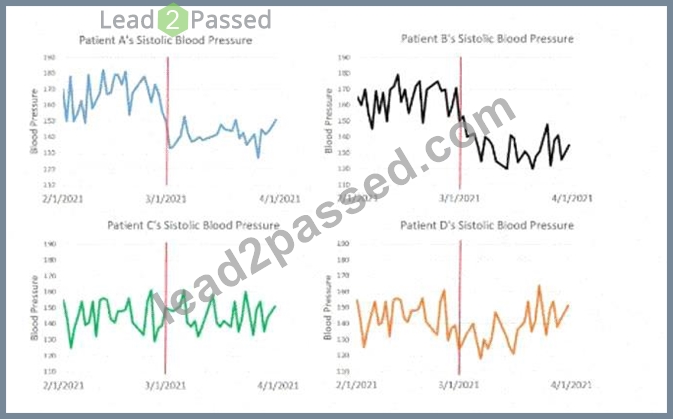
- A. Every client's blood pressure decreased over time.
- B. Some clients' systolic blood pressure tended to decrease over time.
- C. The new medication caused a decrease in all clients' blood pressure.
- D. The new medication caused more variability in blood pressure.
Answer: B
Explanation:
This problem tests data interpretation and inference. The graphs show different patterns for each client. Some clients clearly show a decrease in systolic blood pressure after starting the medication, while others show little change or variability. Because not all clients show a decrease, options C and D are incorrect. Option B suggests increased variability, which is not consistently supported across all graphs. Option A accurately summarizes the data by stating thatsomeclients experienced a decrease. On the NEX exam, inference questions often require cautious conclusions rather than absolute statements. Words like "some" and "tended to" are important clues to correct answers.
======
NEW QUESTION # 33
In which biochemical family do starch and glycogen belong?
- A. Lipids
- B. Carbohydrates
- C. Nucleic acids
- D. Proteins
Answer: B
Explanation:
Starch and glycogen are both polysaccharides, which are complex carbohydrates composed of many glucose units. Starch is the primary storage form of glucose in plants, while glycogen is the storage form of glucose in animals, particularly in the liver and muscles. Carbohydrates serve as a major energy source for cells. Nucleic acids store genetic information, proteins perform structural and enzymatic functions, and lipids are involved in energy storage and membrane structure. The NEX Science exam often tests classification of biomolecules and their functions, making carbohydrates the correct answer.
======
NEW QUESTION # 34
A student is traveling out of the United States to visit family living in Europe. The room booked for the trip costs €120.00 per night.
Given that $1.00 (US dollar) is equal to €1.2, how much will it cost per night in US Dollars?
- A. $100.00
- B. $120.01
- C. $120.00
- D. $144.00
Answer: A
Explanation:
This problem involves currency conversion. The exchange rate states that $1 equals €1.2. To convert euros to dollars, divide the euro amount by 1.2. Set up the calculation: €120 ÷ 1.2 = $100. Therefore, the cost per night in US dollars is $100. Option C is correct. Option B incorrectly multiplies instead of dividing. Options A and D fail to account for the exchange rate. NEX math problems involving currency emphasize understanding the direction of conversion and selecting the correct operation.
======
NEW QUESTION # 35
Reading Comprehension
Passage:
Time management is an important skill for students in demanding programs. Creating schedules, prioritizing tasks, and setting realistic goals can reduce stress and improve academic performance.
Which strategy is mentioned as a way to improve time management?
- A. Working without schedules
- B. Studying without breaks
- C. Prioritizing tasks
- D. Avoiding deadlines
Answer: C
Explanation:
The passage discusses several strategies that help improve time management, including creating schedules, prioritizing tasks, and setting realistic goals. Option B directly reflects one of these strategies. The other options contradict or ignore the recommendations in the passage. Avoiding deadlines and working without schedules would worsen time management, and studying without breaks is not mentioned. On the NEX exam, reading comprehension questions often focus on identifying practical strategies or recommendations explicitly stated in the passage. Selecting prioritizing tasks demonstrates accurate understanding of the author's suggestions.
======
NEW QUESTION # 36
Word Knowledge
The word"beneficial"most nearly means:
- A. Harmful
- B. Costly
- C. Accidental
- D. Helpful
Answer: D
Explanation:
"Beneficial" describes something that produces a positive effect or advantage. "Helpful" is the closest synonym. The other options do not match the meaning. NEX vocabulary questions often test commonly used healthcare-related words.
======
NEW QUESTION # 37
Word Knowledge
The word"interpret"most nearly means:
- A. Explain the meaning
- B. Delay action
- C. Ignore
- D. Memorize
Answer: A
Explanation:
Interpret means to explain or understand the meaning of information. Option B correctly defines the term.
Interpretation skills are frequently referenced in healthcare and testing environments.
======
NEW QUESTION # 38
Reading Comprehension
Passage:
Physical therapy can help patients regain strength, mobility, and independence after injury or surgery.
Treatment plans are individualized based on patient needs and progress.
Which idea is directly stated in the passage?
- A. Physical therapy guarantees full recovery
- B. Therapy plans are the same for all patients
- C. Physical therapy replaces surgery
- D. Physical therapy improves mobility
Answer: D
Explanation:
The passage explicitly states that physical therapy helps patients regain strength and mobility. Option C is directly supported. The other options introduce claims not made in the passage. On the NEX exam, direct- statement questions require selecting information that is clearly mentioned, not inferred.
======
NEW QUESTION # 39
Which of the following molecules is an electrolyte normally found in the blood?
- A. Lactase
- B. H#O
- C. Ca²#
- D. Iodine
Answer: C
Explanation:
Electrolytes are charged ions that help regulate nerve function, muscle contraction, and fluid balance in the body. Calcium ions (Ca²#) are an important electrolyte found in the blood and play a crucial role in muscle contraction, blood clotting, and nerve signaling. Water is not an electrolyte because it does not carry a charge.
Iodine is a trace element but not a primary blood electrolyte. Lactase is an enzyme involved in digestion, not an electrolyte. The NEX Science section often includes questions related to human physiology and emphasizes understanding ions and their roles in body function.
======
NEW QUESTION # 40
Review the image below.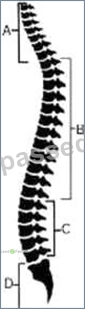
In which part of the spinal column are the vertebrae depicted by bracket B located?
- A. Thoracic
- B. Lumbar
- C. Cervical
- D. Sacral
Answer: A
Explanation:
This question tests knowledge of spinal anatomy and the ability to interpret labeled diagrams, which is common on the NEX Science exam. The vertebral column is divided into regions: cervical (neck), thoracic (upper and mid-back), lumbar (lower back), sacral, and coccygeal regions. In the image, bracket B corresponds to the long middle portion of the spine where ribs attach. This region contains the thoracic vertebrae, which are larger than cervical vertebrae but smaller than lumbar vertebrae and are uniquely characterized by rib articulation. The sacral region is located below the lumbar spine and consists of fused vertebrae, while the cervical region is at the top of the spine near the skull. The lumbar region is shorter and thicker, designed to support body weight. Because bracket B shows the rib-bearing portion of the spine, the correct answer is thoracic. The NEX often assesses spatial understanding of skeletal structures using diagrams.
======
NEW QUESTION # 41
Given that military time uses a 24-hour clock, what time isof a day past 9:15 a.m. in military time?
- A. 12:15 hours
- B. 05:15 hours
- C. 21:15 hours
- D. 17:15 hours
Answer: D
Explanation:
This question combines fractions of time and military time. One full day is 24 hours. One-third of a day equals 24 ÷ 3 = 8 hours. Add 8 hours to 9:15 a.m. Doing so results in 5:15 p.m. In military time, p.m. hours are converted by adding 12 to the hour: 5:15 p.m. becomes 17:15. Therefore, option A is correct. Option C would represent noon, and option D is early morning. The NEX often tests time interpretation, so remembering that military time does not use "a.m." or "p.m." is critical.
======
NEW QUESTION # 42
When an individual sustains a torn ligament, the connection between which two structures is disrupted?
- A. Bone to artery
- B. Bone to bone
- C. Muscle to bone
- D. Muscle to nerve
Answer: B
Explanation:
Ligaments are strong bands of connective tissue that connect bone to bone at joints. Their primary function is to stabilize joints and prevent excessive movement. When a ligament is torn, the connection between two bones is disrupted, leading to joint instability. Tendons, not ligaments, connect muscle to bone. Nerves transmit electrical signals, and arteries transport blood. The NEX Science exam frequently includes musculoskeletal system questions that require distinguishing between ligaments and tendons, making bone-to- bone the correct answer.
======
NEW QUESTION # 43
......
BEST Verified NLN NEX Exam Questions (2026) : https://certblaster.lead2passed.com/NLN/NEX-practice-exam-dumps.html