

Free Apr-2024 AZ-600 Certification Sample Questions certification Exam
Certification Topics of AZ-600 Exam PDF Recently Updated Questions
The AZ-600 exam is intended for professionals who work in IT departments, cloud operations, and cloud architecture. It is ideal for those who are responsible for designing, implementing, and managing hybrid cloud environments using Microsoft Azure Stack Hub. Configuring and Operating a Hybrid Cloud with Microsoft Azure Stack Hub certification validates the candidate's knowledge and skills in cloud administration and opens up new career opportunities in the field of cloud computing.
The Configuring and Operating a Hybrid Cloud with Microsoft Azure Stack Hub certification is highly valued in the IT industry as it demonstrates a candidate's ability to design, implement, and manage complex hybrid cloud environments. It is also an excellent way to showcase your skills and expertise to potential employers, as well as to enhance your career prospects.
NEW QUESTION # 68
Your company is a Cloud Solution Provider (CSP) that provides Azure Stack Hub services to multiple customers in a multitenant environment.
User subscriptions are linked to Azure CSP subscriptions for billing reconciliation.
You need to view the usage of all the customers for the current day and the last seven days.
What should you do?
- A. Query the Partner Center Usage API
- B. From Partner Center, view the usage associated to the Azure Partner Shared Services (APSS) subscription
- C. From Partner Center, download the daily-rated usage reconciliation CSV
- D. Query the Azure Stack Hub usage API
Answer: A
Explanation:
Reference:
https://docs.microsoft.com/en-us/azure-stack/operator/azure-stack-provider-resource-api?view=azs-2008
NEW QUESTION # 69
Note: This question is part of a series of questions that present the same scenario. Each question in the series contains a unique solution that might meet the stated goals. Some question sets might have more than one correct solution, while others might not have a correct solution.
After you answer a question in this section, you will NOT be able to return to it. As a result, these questions will not appear in the review screen.
You deploy a disconnected Azure Stack Hub integrated system.
You need to identify the IP address of the privileged endpoint (PEP).
Solution: From the administrator portal of Azure Stack Hub, you review the Region management blade.
Does this meet the goal?
- A. Yes
- B. No
Answer: B
Explanation:
Explanation
Instead: Solution: You run the nslookup AzS-ERCS01.azurestack.local command.
Note: nslookup is a network administration command-line tool for querying the Domain Name System to obtain the mapping between domain name and IP address, or other DNS records.
ASDK architecture, Virtual machine roles
The ASDK offers services using the following VMs hosted on the development kit host computer:
* AzS-ERCS01 - Emergency Recovery Console VM.
Reference:
https://docs.microsoft.com/en-us/azure-stack/asdk/asdk-architecture?view=azs-2008
NEW QUESTION # 70
You start the update of an Azure Stack Hub integrated system. The Update run details are shown in the following exhibit.
Use the drop-down menus to select the answer choice that completes each statement based on the information presented in the graphic.
NOTE: Each correct selection is worth one point.
Answer:
Explanation:
Explanation
Reference:
https://docs.microsoft.com/en-us/azure-stack/operator/azure-stack-apply-updates?view=azs-2008
NEW QUESTION # 71
You need to change the int1 region to use the capacity model. The solution must meet the technical requirements.
Which three actions should you perform in sequence? To answer, move the appropriate actions from the list of actions to the answer area and arrange them in the correct order.
Answer:
Explanation:
Explanation
NEW QUESTION # 72
You have a disconnected Azure Stack Hub integrated system that contains a user named User1.
You need to ensure that User1 can assign role-based access control (RBAC) roles in Azure Stack Hub. The solution must use the principle of least privilege.
Which Azure Stack Hub built-in role should you assign to User1?
- A. User Access Administrator
- B. Security Admin
- C. Managed Identity Contributor
- D. Owner
Answer: A
Explanation:
Explanation
User Access Administrator
Lets you manage user access to Azure resources.
*/read Read resources of all types, except secrets.
Microsoft.Authorization/* Manage authorization
Microsoft.Support/* Create and update a support ticket
Reference:
https://learn.microsoft.com/en-us/azure/role-based-access-control/built-in-roles
NEW QUESTION # 73
You have an Azure Stack Hub integrated system that uses an Azure Active Directory (Azure AD) tenant named contoso.onmicrosoft.com as an identity provider.
You need to ensure that users from an Azure AD tenant named fabrikam.onmicrosoft.com can authenticate to the integrated system.
Which four actions should you perform in sequence? To answer, move the appropriate actions from the list of actions to the answer area and arrange them in the correct order.

Answer:
Explanation:
1 - Download AzureStack-Tools
2 - Import the Directory module
3 - Configure the contoso.onmicrosoft.com Azure AD tenant to allow sign-ins from fabrikam...
4 - From the fabrikam.onmicrosoft.com Azure aD tenant, register the Azure stack Hub directory Reference:
https://docs.microsoft.com/en-us/azure-stack/operator/azure-stack-enable-multitenancy?view=azs-2008
NEW QUESTION # 74
In which three situations should you update the registration of an Azure Stack Hub integrated system? Each correct answer presents a complete solution.
NOTE: Each correct selection is worth one point.
- A. when you enable Azure Stack Hub for multitenancy
- B. when you renew an annual capacity subscription
- C. when you update the Azure Active Directory (Azure AD) home directory
- D. when you change the billing model
- E. when you add or remove nodes for consumption-based billing
- F. when you add or remove nodes for capacity-based billing
Answer: B,D,F
NEW QUESTION # 75
You need to identify the certificate for the integrated system in Chicago. The solution must meet the technical requirements.
What should you identify? To answer, select the appropriate options in the answer area.
NOTE: Each correct selection is worth one point.
Answer:
Explanation:
Reference:
https://docs.microsoft.com/en-us/azure-stack/operator/azure-stack-pki-certs?view=azs-2008
NEW QUESTION # 76
You have an Azure Stack Hub integrated system that is enabled for multitenancy and uses an Azure Active Directory (Azure AD) tenant named fabrikam.com as an identity provider.
The integrated system has the following guest directory tenants onboarded and enabled for multitenancy:
* com
* onmicrosoft.com
* onmicrosoft.com
You need to verify whether all the guest directory tenants are registered properly.
How should you complete the PowerShell script? To answer, drag the appropriate cmdlet to the correct targets.
Each cmdlet may be used once, more than once, or not at all. You may need to drag the split bar between panes or scroll to view content.
NOTE: Each correct selection is worth one point.
Answer:
Explanation:
Explanation
Reference:
https://docs.microsoft.com/en-us/azure-stack/operator/azure-stack-enable-multitenancy?view=azs-2008
NEW QUESTION # 77
Note: This question is part of a series of questions that present the same scenario. Each question in the series contains a unique solution that might meet the stated goals. Some question sets might have more than one correct solution, while others might not have a correct solution.
After you answer a question in this section, you will NOT be able to return to it. As a result, these questions will not appear in the review screen.
You plan to install an update to an Azure Stack Hub integrated system.
You need to verify whether the integrated system is healthy, and whether you can apply the update. You must achieve the goal as quickly as possible.
Solution: From the administrator management endpoint, you run Test-AzureStack -Group "Default".
Does this meet the goal?
- A. Yes
- B. No
Answer: B
Explanation:
Explanation
Correct: Solution: From a privileged endpoint (PEP) session, you run
Test-AzureStack -Group "UpdateReadiness".
Use a privileged endpoint (PEP) session and Test-AzureStack with UpdateReadiness.
Note:
Running the validation tool and accessing results
You can use the PEP to run the validation tool. The tool can take a while to run. The length of the time depends on the number of virtual machines in your system. Each test returns a PASS/FAIL status in the PowerShell window.
Here's an outline of the end-to-end validation testing process:
1. Establish the trust. On an integrated system, run the following command from an elevated Windows PowerShell session to add the PEP as a trusted host on the hardened VM running on the hardware lifecycle host or the Privileged Access Workstation.
2. Access the PEP.
3. Once you're in the PEP, run:
Test-AzureStack
Groups
To improve the operator experience, a Group parameter has been enabled to run multiple test categories at the same time. Currently, there are three groups defined: Default, UpdateReadiness, and SecretRotationReadiness.
UpdateReadiness: A check to see if the Azure Stack Hub instance can be updated. When the UpdateReadiness group is run, warnings are displayed as errors in the console output, and they should be considered as blockers for the update.
Reference:
https://docs.microsoft.com/en-us/azure-stack/operator/azure-stack-diagnostic-test?view=azs-2008
NEW QUESTION # 78
Your company is a Cloud Solution Provider (CSP) that provides Azure Stack Hub services to multiple customers in a multitenant environment.
User subscriptions are linked to Azure CSP subscriptions for billing reconciliation.
You need to view the usage of all the customers for the current day and the last seven days.
What should you do?
- A. Query the Partner Center Usage API
- B. From Partner Center, view the usage associated to the Azure Partner Shared Services (APSS) subscription
- C. From Partner Center, download the daily-rated usage reconciliation CSV
- D. Query the Azure Stack Hub usage API
Answer: A
Explanation:
Explanation/Reference:
https://docs.microsoft.com/en-us/azure-stack/operator/azure-stack-provider-resource-api?view=azs-2008
NEW QUESTION # 79
You need to implement disaster recovery for the priv1 region to meet the technical requirements.
Which main components should you include in the disaster recovery plan?
- A. Option D
- B. Option C
- C. Option A
- D. Option B
Answer: C
NEW QUESTION # 80
You have an Azure Stack Hub integrated system that has syslog forwarding configured.
You need to remove syslog forwarding and the associated certificate.
Which three actions should you perform in sequence? To answer, move the appropriate actions from the list of actions to the answer area and arrange them in the correct order.
Answer:
Explanation: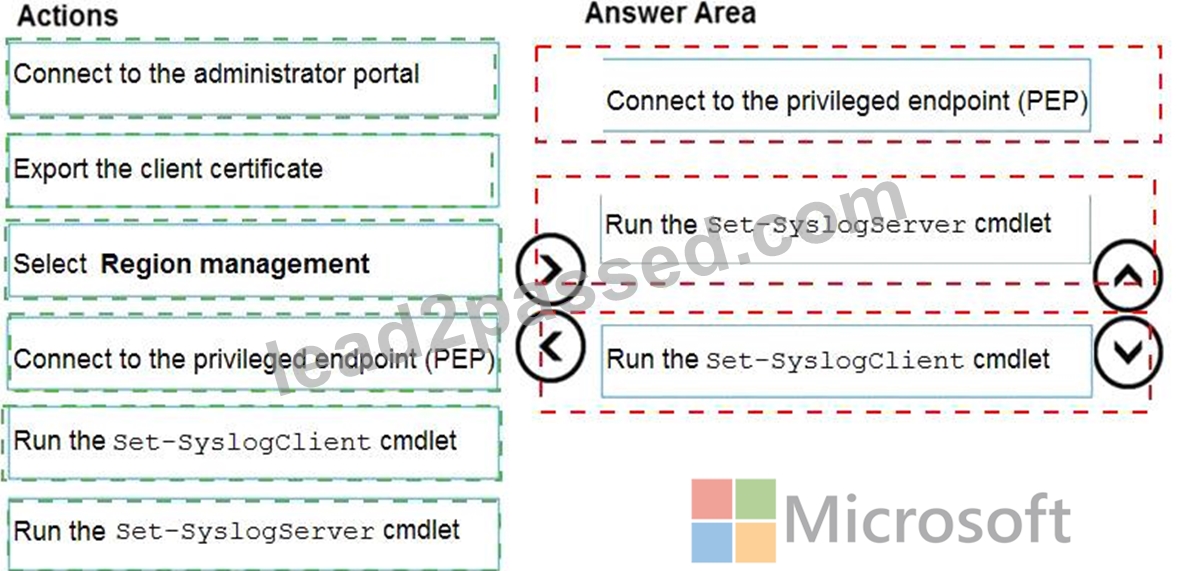
Explanation
Reference:
https://docs.microsoft.com/en-us/azure-stack/operator/azure-stack-integrate-security?view=azs-2008
NEW QUESTION # 81
Note: This question is part of a series of questions that present the same scenario. Each question in the series contains a unique solution that might meet the stated goals. Some question sets might have more than one correct solution, while others might not have a correct solution.
After you answer a question in this section, you will NOT be able to return to it. As a result, these questions will not appear in the review screen.
You have an Azure Stack Hub integrated system that connects to the Internet. The integrated system uses an Enterprise Agreement (EA) for licensing.
You are creating an Azure Resource Manager template to generate a marketplace item for a virtual machine that runs Windows Server 2019 Datacenter and a custom application.
You need to ensure that Windows Server is licensed by using the bring-your-own-license model.
Solution: You add licenseType: Windows_Server to the Azure Resource Manager template.
Does this meet the goal?
- A. Yes
- B. No
Answer: A
Explanation:
Topic 1, Northwind Traders
Case study
This is a case study. Case studies are not timed separately. You can use as much exam time as you would like to complete each case. However, there may be additional case studies and sections on this exam. You must manage your time to ensure that you are able to complete all questions included on this exam in the time provided.
To answer the questions included in a case study, you will need to reference information that is provided in the case study. Case studies might contain exhibits and other resources that provide more information about the scenario that is described in the case study. Each question is independent of the other questions in this case study.
At the end of this case study, a review screen will appear. This screen allows you to review your answers and to make changes before you move to the next section of the exam. After you begin a new section, you cannot return to this section.
To start the case study
To display the first question in this case study, click the button. Use the buttons in the left pane to explore the content of the case study before you answer the questions. Clicking these buttons displays information such as business requirements, existing environment, and problem statements. If the case study has an All Information tab, note that the information displayed is identical to the information displayed on the subsequent tabs. When you are ready to answer a question, click the button to return to the question.
Overview
A company named Northwind Traders has a main office and a datacenter. All development occurs at the main office.
Existing Environment
Identity Environment
The network contains an Active Directory forest named northwind.com. The forest and an Azure Active Directory (Azure AD) tenant named northwind.onmicrosoft.com are integrated by using Active Directory Federation Service (AD FS).
All Azure subscriptions use the northwind.onmicrosoft.com Azure AD tenant.
Northwind Traders uses an Enterprise Agreement (EA) subscription.
All operators are global administrators in northwind.onmicrosoft.com.
Azure Stack Hub Environment
Northwind Traders has the following five Azure Stack Hub integrated systems:
* One integrated system that connects to an internet-facing network and has the following configurations:
- The region name is int1.
- The operators do not have access to the user subscriptions.
- The integrated system is used for customer and partner applications.
- The partners and customers of NorthWind Traders use guest user accounts to access various user resources.
* Two integrated systems that connect to a private network, are accessed only from inside the company, and have the following configurations:
- The integrated systems are dedicated to research and development.
- One integrated system has a region name of priv1, and the other has a region name of priv2.
- The integrated systems are used for various data rendering, AI workloads, inference, and data visualization.
* Two integrated systems that are dedicated to application development and have the following configurations:
- The integrated systems are disconnected from the Internet. The workloads in the user subscriptions have Internet access.
- One integrated system has a region name of dev1, and the other has a region name of dev2.
- Both regions are used only by developers at Northwind Traders.
The external domain name of all the integrated systems is northwind.com. All the integrated systems have Azure App Service and the Azure Kubernetes Service (AKS) engine deployed.
The computer of the operator in each region has all the prerequisite software installed for managing Azure Stack Hub.
Current Problems
You identify the following issues in the current environment:
* The priv2 region recently experienced a catastrophic failure.
* The developers report high chargeback costs for the dev1 region.
* The int1 region runs a high number of Windows virtual machines that use pay-as-you-use images.
* The Northwind Traders partners and customers report that use of the guest user accounts is too complex.
* Users in the priv1 region recently deployed NCas_v4 virtual machines for various AI workload. The users discover that the virtual machines do not use GPUs.
Requirements
Planned Changes
Northwind Traders plans to implement the following changes:
* Remove all guest user accounts.
* Change the DNS forwarder of the priv1 region.
* Change the billing model and registration name of the int1 region.
* After the catastrophic failure, restore the priv2 region to its original state.
* Provide each partner with its own dedicated user subscription that will use its own dedicated Azure AD tenant.
Technical Requirements
Northwind Traders identifies the following technical requirements:
* Minimize hardware and software costs.
* Standardize all datacenter workloads on Azure Stack Hub.
* In the priv1 region, implement a disaster recovery plan for App Service.
* Whenever possible, implement solutions by using the minimum amount of administrative effort.
* In the dev2 region, update the AKS Base Ubuntu image to the latest version in Azure Stack Hub Marketplace.
* Whenever possible, implement solutions by using built-in tools, features, and services without acquiring additional third-party tools.
* For the users' virtual machines and the associated resources in the dev1 and dev2 regions, implement a business continuity and disaster recovery plan that includes an automated failback process.
* If changes to the Azure Stack Hub infrastructure cause workload downtime outside of planned maintenance windows, notify all users in the region where the downtime occurred and schedule a maintenance window.
NEW QUESTION # 82
You have a corrected Azure Stack Hub integrated system.
You need to query the health status of the Key Vault resource provider by using PowerShell Which three actions should you perform in sequence? To answer move the appropriate actions from the list of actions to the answer area and arrange them in the correct order.
Answer:
Explanation:
Explanation
NEW QUESTION # 83
Note: This question is part of a series of questions that present the same scenario. Each question in the series contains a unique solution that might meet the stated goals. Some question sets might have more than one correct solution, while others might not have a correct solution.
After you answer a question in this section, you will NOT be able to return to it. As a result, these questions will not appear in the review screen.
You have an Azure Stack Hub integrated system.
The security department at your company wants a list of all the users who can manage the integrated system from the privileged endpoint (PEP).
You need to create the list.
Solution: You connect to the administrator portal and view the users who are assigned the Owner role for the default provider subscription.
Does this meet the goal?
- A. Yes
- B. No
Answer: B
Explanation:
Reference:
https://docs.microsoft.com/en-us/azure-stack/reference/pep-2002/get-cloudadminuserlist
NEW QUESTION # 84
You have an Azure Stack Hub integrated system.
You need to delegate the management of offers to a user named User1.
Which three actions should you perform in a sequence? To answer, move the appropriate actions from the list of actions to the answer area and arrange them in the correct order.
Answer:
Explanation:
Explanation
Reference:
https://docs.microsoft.com/en-us/azure-stack/operator/azure-stack-delegated-provider?view=azs-2008
NEW QUESTION # 85
You have an Azure Stack Hub integrated system.
The retention period for storage accounts is set to 7 days.
A user reports that a storage account named hr12943 was deleted accidentally two days ago.
You need to restore hr12943.
Which four actions should you perform in sequence? To answer, move the appropriate actions from the list of actions to the answer area and arrange them in the correct order.
Answer:
Explanation:
Explanation
Step 1: Connect to the administrator portal
Find a storage account
The list of storage accounts in the region can be viewed in Azure Stack Hub by following these steps:
1. Sign in to the administrator portal https://adminportal.local.azurestack.external.
2. Select All services > Storage > Storage accounts.
By default, the first 10 accounts are displayed. You can choose to fetch more by clicking the Load more link at the bottom of the list.
Step 2: Open the Storage accounts blade.
Step 3: Select hr12943.
Once you've located the accounts you're interested in viewing, you can select the particular account to view certain details. A new pane opens with the account details. These details include the kind of account, creation time, location, and so on.
Step 4: Select Recover.
Recover a deleted account
You may be in a situation where you need to recover a deleted account.
In Azure Stack Hub, there's a simple way to do that:
* Browse to the storage accounts list. For more information, see Find a storage account at the top of this article.
* Locate that particular account in the list. You may need to filter.
* Check the state of the account. It should say Deleted.
* Select the account, which opens the account details pane. (Step 3 above)
* On top of this pane, locate the Recover button and select it. (Step 4)
* Select Yes to confirm.
Reference:
https://learn.microsoft.com/en-us/azure-stack/operator/azure-stack-manage-storage-accounts
NEW QUESTION # 86
You have an Azure Stack Hub integrated system that has syslog forwarding configured.
You need to remove syslog forwarding and the associated certificate.
Which three actions should you perform in sequence? To answer, move the appropriate actions from the list of actions to the answer area and arrange them in the correct order.
Answer:
Explanation: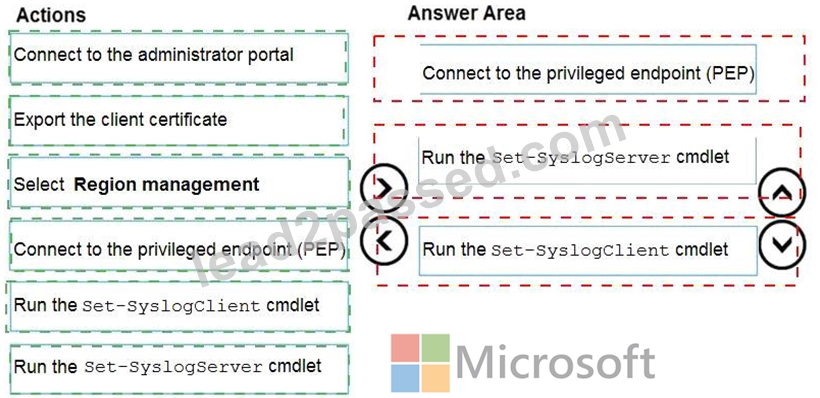
Explanation
Reference:
https://docs.microsoft.com/en-us/azure-stack/operator/azure-stack-integrate-security?view=azs-2008
NEW QUESTION # 87
You have a connected Azure Stack Hub integrated system.
You deploy an Operator Access Workstation (OAW).
You need to sign in to the OAW.
Which account should you use?
- A. AzureStackAdmin
- B. CloudAdmin
- C. GUser
- D. AdminUser
Answer: D
Explanation:
User account policy
The following user account policy is applied to the OAW VM:
Built-in Administrator username: AdminUser
MinimumPasswordLength = 14
PasswordComplexity is enabled
MinimumPasswordAge = 1 (day)
MaximumPasswordAge = 42 (days)
NewGuestName = GUser (disabled by default)
Reference:
https://github.com/MicrosoftDocs/azure-stack-docs/blob/main/azure-stack/operator/operator-access-workstation.md
NEW QUESTION # 88
You have an Azure Stack Hub integrated system that is enabled for multi-tenancy and contains a user subscription. The subscription contains a user named User1.
The integrated system has the following configurations:
* Region name: region1
* Fully qualified domain name (FQDN): contoso.com
You need to identify which gallery endpoint URI User1 must use.
How should you complete the script? To answer, drag the appropriate values to the correct targets. Each value may be used once, more than once, or net at all. You may need to drag the split bar between panes or scroll to view content.
NOTE: Each correct selection is worth one point.
Answer:
Explanation:
Explanation
Box 1: portal.
A DNS entry is created for each endpoint in the external DNS zone that's specified at deployment time. For example, the user portal is assigned the DNS host entry of portal.<region>.<fqdn>.
* Portal (user)
Portal.<region>.<fqdn>
Box 2: region1.
Note: Once your item has been successfully published to the marketplace, you can delete the content from the storage account.
All default gallery artifacts and your custom gallery artifacts are now accessible without authentication under the following URLs:
https://galleryartifacts.adminhosting.[Region].[externalFQDN]/artifact/20161101/[TemplateName]/DeploymentT
https://galleryartifacts.hosting.[Region].[externalFQDN]/artifact/20161101/[TemplateName]/DeploymentTempla Reference:
https://learn.microsoft.com/en-us/azure-stack/operator/azure-stack-integrate-endpoints
https://learn.microsoft.com/en-us/azure-stack/operator/azure-stack-create-and-publish-marketplace-item
NEW QUESTION # 89
You have an Active Directory federation Services {AD FS) deployment.
You plan to deploy a disconnected Azure Stack Hub integrated system.
You install the Azure Stack Hub Readiness Checker tool.
You need to validate that the AD FS deployment can be used to manage role-based access control (RBAC) roles in Azure Stack Hub.
how should you complete the command? To answer, select the appropriate options m the answer area NOTE: Each correct selection is worth one point.
Answer:
Explanation:
Explanation
NEW QUESTION # 90
You have an Azure Stack Hub integrated system that connects to the internet.
You need to update the Azure Event Hubs service.
Solution: From the Updates blade of the administrator portal, you trigger the installation of the latest update listed in the Resource provider section.
Does this meet the goal?
- A. Yes
- B. No
Answer: B
Explanation:
Explanation
Instead: Solution: From a privileged endpoint (PEP) session, you run the Install-AzsUpdate cmdlet.
You can use the Azure Stack Hub administrative endpoints to monitor and manage your updates. They're accessible with PowerShell. For instructions on getting set up with PowerShell on Azure Stack Hub.
You can use the following PowerShell cmdlet to manage your updates:
* Install-AzsUpdate
Apply a specific update at an update location.
Reference:
https://docs.microsoft.com/en-us/azure-stack/operator/azure-stack-update-monitor?view=azs-2008
NEW QUESTION # 91
Your company is a Cloud Solution Provider (CSP) named contoso.com.
The company has an Azure Stack Hub integrated system enabled for multitenancy.
You plan to add a new customer. For the customer, you already created an Azure user subscription that uses an Azure AD tenant named the fabrikam.com.
You collect the following information:
* Customer subscription ID: Q7daa8e5-f301-4$65-99c3-dUae36620df
* Registration subscription IB 52949927-abbe-4bb0-ae2a-dfe8f9636899
* Registration resource group name: AzureStack
* Registration name: AzureStack-id9de6l0-9Oc4-48ff-b455-d6ad9eb1b7a4
Vou need to ensure that the fabrAam.com user subscription is billed separately from other user subscriptions.
How should you complete the powerShell script? To answer select the appropriate options in the answer area.
NOTE: Each correct selection is worth one point.
Answer:
Explanation:
Explanation
NEW QUESTION # 92
......
Microsoft AZ-600 certification exam is designed for IT professionals who are looking to expand their skillset in configuring and operating a hybrid cloud with Microsoft Azure Stack Hub. AZ-600 exam is ideal for individuals who are responsible for managing and implementing Azure solutions, including hybrid cloud infrastructures. AZ-600 exam measures the candidate's knowledge and expertise in areas like Azure Stack Hub deployment, configuration, and management, as well as networking and security in hybrid cloud environments.
2024 New Preparation Guide of Microsoft AZ-600 Exam: https://certblaster.lead2passed.com/Microsoft/AZ-600-practice-exam-dumps.html