

[Mar 24, 2026] OGEA-101 Practice Exam Dumps - 99% Marks In The Open Group Exam
Updated Verified OGEA-101 Q&As - Pass Guarantee or Full Refund
The Open Group OGEA-101 Exam Syllabus Topics:
| Topic | Details |
|---|---|
| Topic 1 |
|
| Topic 2 |
|
| Topic 3 |
|
| Topic 4 |
|
| Topic 5 |
|
| Topic 6 |
|
NEW QUESTION # 41
Consider the following ADM phases objectives.
Objective:
1.Develop the Target Data Architecture that enables the Business Architecture and the Architecture Vision
2.Develop the Target Business Architecture that describes how the enterprise needs to operate to achieve the business goals
3.Develop a high-level aspirational vision of the capabilities and business value to be delivered as a result of the proposed Enterprise Architecture
4.Identify candidate Architecture Roadmap components based upon gaps between the Baseline and Target Technology Architectures Which phase does each objective match?
- A. 1B-2D-3A-4C
- B. 1C-2D-3B-4A
- C. 1A-2B-3C-4D
- D. 1C-2B-3A-4D
Answer: D
Explanation:
*Phase A: Architecture Vision
oDevelop a high-level aspirational vision of the capabilities and business value to be delivered as a result of the proposed Enterprise Architecture oDefine the scope and boundaries of the architecture engagement oIdentify the key stakeholders and their concerns and expectations oDefine the Architecture Vision statement and the Architecture Definition Document oObtain approval and commitment from the sponsors and stakeholders
*Phase B: Business Architecture
oDevelop the Target Business Architecture that describes how the enterprise needs to operate to achieve the business goals oDefine the Baseline Business Architecture, if not available oPerform a gap analysis between the Baseline and Target Business Architectures oDefine candidate roadmap components for the Business Architecture oResolve impacts across the Architecture Landscape
*Phase C: Information Systems Architecture
oDevelop the Target Data Architecture that enables the Business Architecture and the Architecture Vision oDevelop the Target Application Architecture that supports the Business Architecture and the Architecture Vision oDefine the Baseline Data and Application Architectures, if not available oPerform a gap analysis between the Baseline and Target Data and Application Architectures oDefine candidate roadmap components for the Information Systems Architecture oResolve impacts across the Architecture Landscape
*Phase D: Technology Architecture
oDevelop the Target Technology Architecture that enables the Information Systems Architecture and the Architecture Vision oDefine the Baseline Technology Architecture, if not available oPerform a gap analysis between the Baseline and Target Technology Architectures oIdentify candidate Architecture Roadmap components based upon gaps between the Baseline and Target Technology Architectures oResolve impacts across the Architecture Landscape Therefore, the correct matching of the objectives and the phases is:
*1C: Develop the Target Data Architecture that enables the Business Architecture and the Architecture Vision
*2B: Develop the Target Business Architecture that describes how the enterprise needs to operate to achieve the business goals
*3A: Develop a high-level aspirational vision of the capabilities and business value to be delivered as a result of the proposed Enterprise Architecture
*4D: Identify candidate Architecture Roadmap components based upon gaps between the Baseline and Target Technology Architectures References: 1: The TOGAF Architecture Development Method
NEW QUESTION # 42
Complete the sentence. Architecture effort at the Logical abstraction level is about:
- A. Understanding the environment in which an enterprise operates and the context in which architecture work is planned and executed
- B. Identifying the kinds of business, data, application, and technology components needed to achieve the services identified in the conceptual level
- C. Decomposing the requirements to understand the problem, and what is needed to address the problem, without unduly focusing on how the architecture will be realized
- D. Managing the allocation and implementation of physical components to meet the identified logical components
Answer: B
Explanation:
(Authoritative Open Group guidance distinguishes conceptual, logical, and physical concerns; at the logical level, component types are identified independently of implementation.) For example, the Open Group's metamodel guidance emphasizes technology-agnostic structure to ensure consistency within an architecture description, which is precisely what the logical level captures before physical realization.
"The Content Metamodel defines a formal structure... to ensure consistency within the architecture description and also to provide guidance for organizations that wish to implement their architecture within an architecture tool." Open Group Publications Reference: The Open Group, TOGAF 9 Conformance Requirements (Content Framework overview); Open Group Whitepaper TOGAF 9 Conformance Requirements-Content Metamodel description.
Note: TOGAF Series Guides (member library) explicitly define the four abstraction levels; the logical level focuses on the "what (structure) independent of technology." The cited Content Metamodel text underpins this by mandating technology-agnostic structure for consistency.
NEW QUESTION # 43
Which statement best summarizes the TOGAF Content Framework?
- A. It is fixed and should not be changed or modified.
- B. It is organized based on the phases of ADM.
- C. It provides lifecycle management capabilities to create and manage architectures.
- D. It shows the detailed relationships and interactions between information entities.
Answer: D
Explanation:
* The TOGAF Content Framework defines a detailed model of architectural work products (artifacts, deliverables, building blocks) and the relationships between them.
* It is not a lifecycle management capability (A), that is related to the ADM itself.
* It is not organized strictly by ADM phases (B).
* It is not fixed; it is designed to be tailored (C).
Reference: TOGAF Standard, Version 9.2, Part IV: Architecture Content Framework.
NEW QUESTION # 44
Which of the following best summarizes the purpose of Enterprise Architecture?
- A. Governing the Stakeholders.
- B. Taking major improvement decisions.
- C. Guiding effective change.
- D. Controlling the bigger changes.
Answer: C
Explanation:
EA applies architecture principles and practices to analyze, design, plan, and implement enterprise analysis that supports digital transformation, IT growth, and the modernization of IT2. EA also helps organizations improve the efficiency, timeliness, and reliability of business information, as well as the alignment, agility, and adaptability of the architecture to the changing needs and requirements3. Therefore, the best summary of the purpose of EA is to guide effective change.
References: 1: Enterprise architecture - Wikipedia 2: What is enterprise architecture? A framework for transformation 3: 3 The Purpose of Enterprise Architecture - The Open Group
NEW QUESTION # 45
Consider the illustration.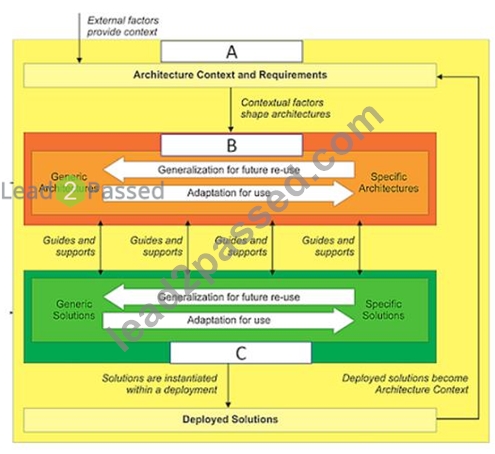
What are the items labelled A, B and C?
- A. A-Enterprise Continuum, B-Architecture Continuum, C-Solutions Continuum
- B. A-Architecture Vision, B-Business Architecture, C-Information Systems Architecture
- C. A-Enterprise Architecture, B-Architecture Building Blocks, C-Solutions Building Blocks
- D. A-Enterprise Strategic Architecture, B-Segment Architecture, C-Solutions Architecture
Answer: A
Explanation:
The illustration shows the relationship between the Enterprise Continuum, the Architecture Continuum, and the Solutions Continuum, which are key concepts in the TOGAF framework. The Enterprise Continuum is a view of the Architecture Repository that shows how generic foundation architectures can be leveraged and specialized to support the requirements of an individual organization. The Architecture Continuum specifies a structured classification for architectural artifacts, such as models, patterns, and descriptions, that can be reused and adapted across different domains and levels of abstraction. The Solutions Continuum identifies implemented solutions that support various stages of business and IT capability evolution, such as common systems, industry solutions, and organization-specific solutions. The illustration also shows how the architecture context and requirements are influenced by external factors, such as business drivers, stakeholders, and standards, and how they shape the generic and specific architectures and solutions. The illustration also shows how the deployed solutions become part of the architecture context for future iterations of the architecture development cycle. Reference:
* TOGAF Standard, 10th Edition, Part II: Architecture Development Method, Chapter 6: Architecture Repository, Section 6.2 Enterprise Continuum.
* TOGAF Standard, 10th Edition, Part IV: Architecture Content Framework, Chapter 35: Enterprise Continuum and Tools, Section 35.1 Introduction.
NEW QUESTION # 46
Which one of the following classes of information within the Architecture Repository would typically contain a list of the applications in use within the enterprise?
- A. Architecture Metamodel
- B. Architecture Landscape
- C. Governance Log
- D. Reference Library
Answer: B
Explanation:
The Architecture Landscape is a class of information within the Architecture Repository that shows an architectural view of the building blocks that are in use within the organization today (the Baseline Architecture), as well as those that are planned for the future (the Target Architecture). The Architecture Landscape typically contains a list of the applications in use within the enterprise, along with their relationships and dependencies, as well as other relevant architectural information. The Architecture Landscape helps to identify opportunities for re-use, consolidation, or retirement of existing applications, as well as gaps or overlaps in the current or future architecture.
The TOGAF Standard, Version 9.2, Part IV: Architecture Content Framework, Chapter 34: Architecture Landscape : The TOGAF Standard, Version 9.2, Part VI: Architecture Capability Framework, Chapter 47:
Architecture Repository
NEW QUESTION # 47
Complete the sentence A business scenario describes______________
- A. shortfalls between the Baseline and Target Architectures
- B. general rules and guidelines tor the architecture being developed
- C. business domain gaps such as cross-training requirements
- D. business and technology environment in which those problems occur
Answer: D
Explanation:
A business scenario describes business and technology environment in which those problems occur. It provides a realistic context for identifying and addressing business problems and opportunities, as well as their impact on the enterprise's architecture. Reference: The TOGAF Standard | The Open Group Website, Section 3.3.1 Business Scenarios.
NEW QUESTION # 48
Consider the following descriptions of deliverables consumed and produced across the TOGAF ADM cycle.
General rules and guidelines, intended to be enduring and seldom
amended, that inform and support the way in which an organization sets
about fulfilling its mission
The joint agreements between development partners and sponsors on the
deliverables, quality, and fitness-for-purpose of an architecture.
A document that is sent from the sponsoring organization to the
architecture organization to trigger the start of an architecture
development cycle
A set of quantitative statements that outline what an implementation
project must do in order to comply with the architecture.
Which deliverables match these descriptions?
- A. 1 Architecture Contracts - 2 Architecture Requirements Specification - 3 Architecture Vision - 4 Architecture Principles
- B. 1 Architecture Principles -2 Architecture Contracts - 3 Request for Architecture Work - 4 Architecture Requirements Specification
- C. 1 Architecture Requirements Specification -2 Architecture Principles - 3 Architecture Vision - 4 Architecture Contracts
- D. 1 Architecture Principles -2 Architecture Contracts - 3 Architecture Requirements Specification-4 Request for Architecture Work
Answer: B
Explanation:
According to the TOGAF standard, the deliverables that match the descriptions are as follows:
1 Architecture Principles: These are general rules and guidelines, intended to be enduring and seldom amended, that inform and support the way in which an organization sets about fulfilling its mission1. They reflect a level of consensus among the various elements of the enterprise, and form the basis for making future IT decisions1.
2 Architecture Contracts: These are the joint agreements between development partners and sponsors on the deliverables, quality, and fitness-for-purpose of an architecture2. They are used to ensure that the architecture is implemented and governed according to the agreed-upon specifications and standards2.
3 Request for Architecture Work: This is a document that is sent from the sponsoring organization to the architecture organization to trigger the start of an architecture development cycle3. It defines the scope, schedule, budget, deliverables, and stakeholders of the architecture project3.
4 Architecture Requirements Specification: This is a set of quantitative statements that outline what an implementation project must do in order to comply with the architecture4. It defines the requirements for each architecture domain, as well as the relationships and dependencies among them4.
NEW QUESTION # 49
What provides context for architecture work, by describing the needs and ways of working employed by the enterprise?
- A. Architecture Contracts
- B. Stakeholder needs
- C. Strategy and vision
- D. Business principles business goals, and business drivers
Answer: D
Explanation:
Business principles business goals, and business drivers provide context for architecture work, by describing the needs and ways of working employed by the enterprise. They define what the enterprise wants to achieve, how it wants to operate, and what factors influence its decisions and actions. Reference: The TOGAF Standard | The Open Group Website, Section 3.2 Preliminary Phase.
NEW QUESTION # 50
In the ADM, what is the name for documents that are not finished and not approved?
- A. incomplete
- B. interim
- C. version 0.1
- D. draft
Answer: D
Explanation:
* In TOGAF, draft deliverables are those that are not yet finished or approved. They are work-in- progress versions that may have version numbers like 0.1, 0.5, or 0.9.
* Once reviewed and approved, they become final deliverables.
Reference: TOGAF Standard, Version 9.2, Deliverables, Artifacts, and Building Blocks.
NEW QUESTION # 51
What structural framework does the TOGAF Standard define to support the management, leverage, and storage of architectural work products?
- A. The Architecture Landscape
- B. The Architecture Repository
- C. The Enterprise Architecture Capability Model
- D. The Architecture Capability
Answer: B
Explanation:
* The Architecture Repository is the structural framework defined by TOGAF to store, manage, and leverage architecture artifacts, including reference models, standards, governance logs, and deliverables.
* The Architecture Capability refers to governance and processes.
* The Architecture Landscape shows Strategic, Segment, and Capability architectures, not storage.
* The Enterprise Architecture Capability Model is not a defined TOGAF concept.
Reference: TOGAF Standard, Version 9.2, Part V: Enterprise Continuum and Tools - Architecture Repository.
NEW QUESTION # 52
Which ADM phase focuses on defining the problem to be solved, identifying the stakeholders, their concerns, and requirements?
- A. Phase
- B. Phase A
- C. Phase
- D. Preliminary Phase
Answer: B
Explanation:
Phase A: Architecture Vision is the first phase of the Architecture Development Method (ADM) cycle, which is the core of the TOGAF standard. The main purpose of this phase is to define the scope and approach of the architecture development, and to create the Architecture Vision, which is a high-level description of the desired outcomes and benefits of the proposed architecture. To achieve this purpose, this phase focuses on defining the problem to be solved, identifying the stakeholders, their concerns, and requirements, and establishing the business goals and drivers that motivate the architecture work. This phase also involves obtaining the approval and commitment of the sponsors and other key stakeholders, and initiating the Architecture Governance process.
NEW QUESTION # 53
Consider the following ADM phases objectives.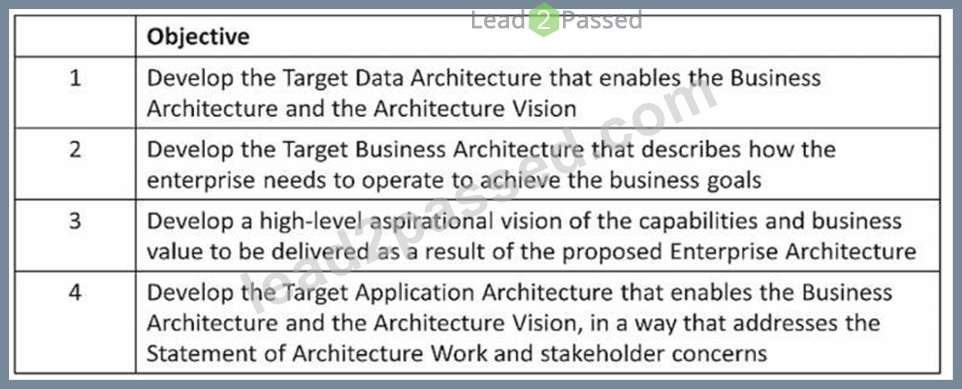
Which phase does each objective match?
- A. 1B-2D-3A-4C
- B. 1C-2B-3A-4C
- C. 1C-2D-3B-4A
- D. 1A-2B-3C-4D
Answer: B
Explanation:
* The objectives listed in the question correspond to the objectives of different phases of the TOGAF ADM (Architecture Development Method), which is a method for developing and managing an enterprise architecture1.
* The ADM consists of nine phases, each with a specific purpose and output. The phases are1:
* Preliminary Phase: To prepare and initiate the architecture development cycle, including defining the architecture framework, principles, and governance.
* Phase A: Architecture Vision: To define the scope, vision, and stakeholders of the architecture initiative, and to obtain approval to proceed.
* Phase B: Business Architecture: To describe the baseline and target business architecture, and to identify the gaps between them.
* Phase C: Information Systems Architectures: To describe the baseline and target data and application architectures, and to identify the gaps between them.
* Phase D: Technology Architecture: To describe the baseline and target technology architecture, and to identify the gaps between them.
* Phase E: Opportunities and Solutions: To identify and evaluate the opportunities and solutions for implementing the target architecture, and to define the work packages and transition architectures.
* Phase F: Migration Planning: To finalize the implementation and migration plan, and to ensure alignment with the enterprise portfolio and project management.
* Phase G: Implementation Governance: To provide architecture oversight and guidance for the implementation projects, and to manage any architecture change requests.
* Phase H: Architecture Change Management: To monitor the changes in the business and technology environment, and to assess the impact and performance of the architecture.
* Based on the above definitions, we can match each objective with the corresponding phase as follows:
* Objective 1: Develop the Target Data Architecture that enables the Business Architecture and the Architecture Vision. This objective is achieved in Phase C: Information Systems Architectures, where the data architecture is defined as a subset of the information systems architecture2.
* Objective 2: Develop the Target Business Architecture that describes how the enterprise needs to operate to achieve the business goals. This objective is achieved in Phase B: Business Architecture, where the business architecture is defined as a subset of the enterprise architecture3.
* Objective 3: Develop a high-level aspirational vision of the capabilities and business value to be delivered as a result of the proposed Enterprise Architecture. This objective is achieved in Phase A: Architecture Vision, where the architecture vision is defined as a high-level description of the target architecture and its benefits4.
* Objective 4: Develop the Target Application Architecture that enables the Business Architecture and the Architecture Vision, in a way that addresses the Statement of Architecture Work and stakeholder concerns. This objective is achieved in Phase C: Information Systems Architectures, where the application architecture is defined as a subset of the information systems architecture2.
NEW QUESTION # 54
Complete the sentence. Actions arising from the Business Transformation Readiness Assessment technique should be incorporated in the
- A. Architecture Roadmap
- B. Implementation and Migration Plan
- C. Architecture Requirements Specification
- D. Implementation Governance Model
Answer: B
Explanation:
The Business Transformation Readiness Assessment technique is used to evaluate the readiness of the organization to undergo change and to identify the actions needed to increase the likelihood of a successful business transformation. These actions should be incorporated in the Implementation and Migration Plan, which is the detailed plan to transition from the Baseline Architecture to the Target Architecture. The Implementation and Migration Plan also includes the Transition Architectures, the Architecture Building Blocks, the Work Packages, the Implementation Governance Model, and the Architecture Contract12 References: 1: The TOGAF Standard, Version 9.2, Part III: ADM Guidelines and Techniques, Chapter 27: Business Transformation Readiness Assessment 2: The TOGAF Standard, Version 9.2, Part II:
Architecture Development Method (ADM), Chapter 21: Phase F: Migration Planning
NEW QUESTION # 55
Complete the sentence. The TOGAF standard covers the development of four architecture domains, Application, Business, Data and ____________
- A. Transition
- B. Segment
- C. Technology
- D. Capability
Answer: C
NEW QUESTION # 56
Which statement about Requirements Management is most correct?
- A. Stakeholder requirements are captured once in Phase A and managed throughout the ADM cycle
- B. The purpose of Requirements Management is to process change requests
- C. Requirements Management and stakeholder engagement are placed at the center of architecture development
- D. Requirements Management is a step of all ADM Phases
Answer: C
Explanation:
This statement about Requirements Management is most correct because it reflects the central role of Requirements Management and stakeholder engagement in the ADM cycle. Requirements Management is not a step of all ADM Phases, but rather an ongoing process that ensures that all relevant requirements are elicited, analyzed, prioritized, and addressed throughout the architecture development and transition. Stakeholder engagement is also a continuous activity that involves identifying, communicating, and managing stakeholder expectations and concerns. Reference: The TOGAF Standard | The Open Group Website, Section 3.1 Introduction to the ADM.
NEW QUESTION # 57
......
OGEA-101 Real Valid Brain Dumps With 136 Questions: https://certblaster.lead2passed.com/TheOpenGroup/OGEA-101-practice-exam-dumps.html